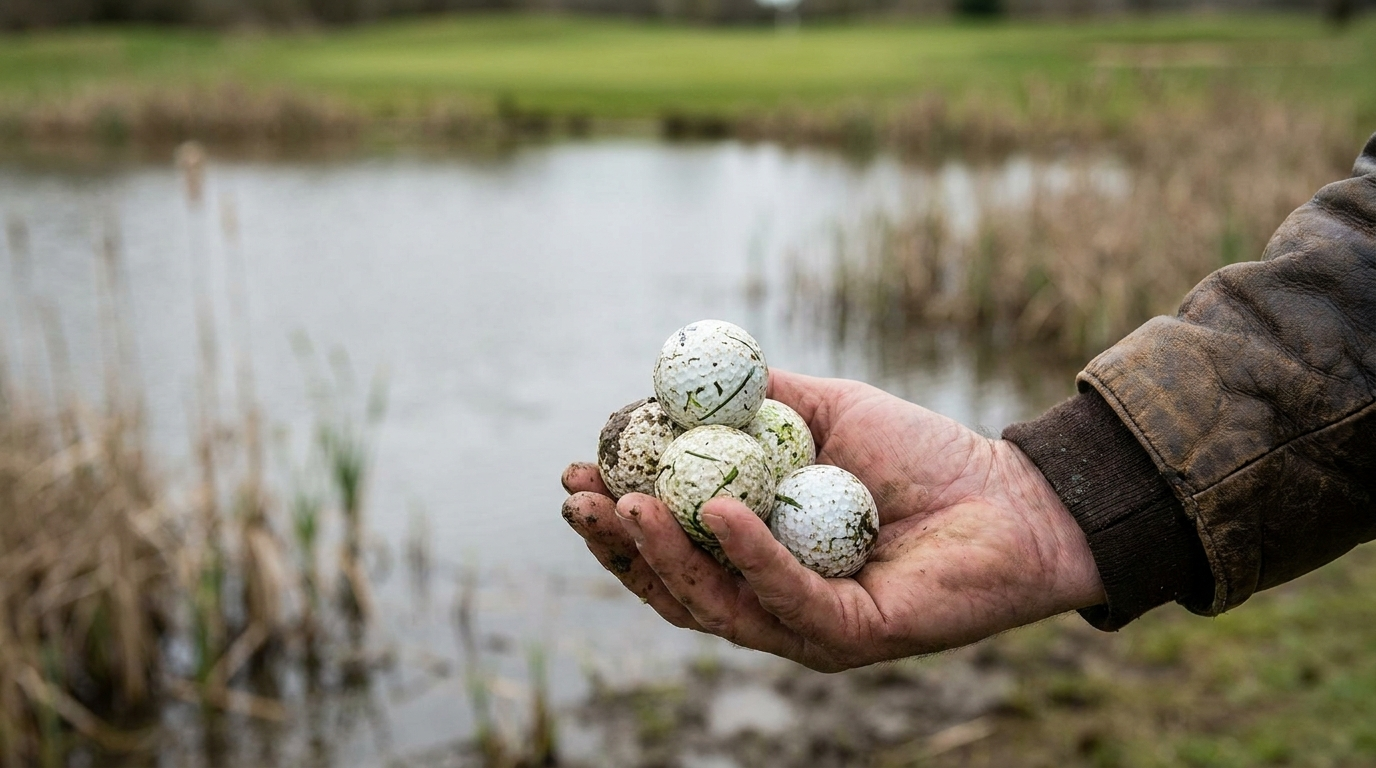
I play a lot of found golf balls. Not “I found one in the woods that one time” golf. I mean a real chunk of what is in my bag on any given round got fished out of a creek, spotted in the weeds while I was looking for my own ball, or flew over from the next fairway. If you play golf the way I do, you do this too. So the question is fair: are found golf balls actually worth playing, or are you better off leaving them in the rough?
Short answer: yes, most found golf balls are absolutely worth playing. But there is a catch with a specific type, and it pays to know the difference.
The “waterlogged ball” myth, and the truth
The old story goes that any ball pulled from a water hazard is ruined. The truth is more interesting. Modern golf balls are sealed pretty well, and a ball with an undamaged cover can sit underwater far longer than you would think before it loses anything.
Here is what the testing actually shows. According to the USGA, most modern balls can stay submerged for one to two years without a noticeable drop in performance, as long as the cover is intact. One study found balls submerged for as long as five months played just like new ones. So that ball you scooped out of the pond last week is almost certainly fine.
The exception is the premium tour ball with a soft urethane cover (think Pro V1 and friends). Those covers absorb water faster, and after a week or so underwater a high-end ball can lose more than 15% of its distance. The irony is great: the $5 ball is the one that goes bad in the water, and the cheap two-piece ball most of us should be playing anyway shrugs it off for months.
Which found balls to keep, and which to toss
You do not need a lab to sort your bucket. Use these simple rules.
Keep and play:
- Two-piece balls with a firm cover (Callaway Supersoft, Titleist TruFeel, Srixon Soft Feel, anything labeled “soft” or “distance”). These are the most water-resistant balls made, and they are exactly the balls a high handicapper should be playing anyway.
- Any ball that looks clean, with no visible cuts, cracks, or deep scuffs. A little dirt or a grass stain means nothing.
Toss or use as a shag ball:
- Anything with a “smile” (that crescent-shaped cut you get from a thin wedge strike). A cut cover lets water in fast, sometimes in as little as six hours.
- Balls with cracks, deep scuffs, or a cover that feels soft and spongy.
- A premium urethane ball you know has been sitting in a pond for a long time. It will still go in the hole, it just will not go as far.
How to check a found ball in ten seconds
- Look it over. Spin it in your hand. Any cut, crack, or crescent and it goes in the practice pile.
- Press the cover. It should feel firm and solid. A waterlogged ball can feel slightly soft or “dead.”
- The bounce test. Drop it on a cart path next to a ball you trust. A good ball bounces back lively. A waterlogged one gives a dull, low bounce. It is not perfectly scientific, but it tells you plenty.
Why this is a smart move for the rest of us
Let’s do the math on being a weekend hacker. If you lose even five or six balls a round (no judgment, same here), buying new balls every time adds up fast. Playing found balls that are in good shape costs you nothing and plays nearly identical to new for the kind of golf most of us play. You get to swing freely instead of babying an expensive ball over water, which honestly makes you play better.
If you want to stock up without crawling through poison ivy, you can also buy bulk recycled golf balls online for a few bucks a dozen, or grab a telescoping ball retriever so you can fish the good ones out of the pond yourself. Both pay for themselves in about one round.
The bottom line
For the average golfer, found golf balls are not just “okay to play,” they are one of the best free upgrades to your wallet in the game. Keep the clean two-piece balls, toss the cut ones, and only be skeptical of premium balls that have clearly done a long swim. Then go lose them all over again like the rest of us.
Frequently asked questions
Do found golf balls really perform as well as new ones?
For most golfers, yes. A clean two-piece ball that has not been cut or soaked for ages plays nearly identical to new. The difference is far smaller than the difference your swing makes.
How can you tell if a golf ball is waterlogged?
Look for cuts or cracks, press the cover to check it feels firm, and do a bounce test against a ball you trust. A dull, low bounce or a soft cover means it has taken on water.
Are water-retrieved golf balls bad?
Not usually. Balls with intact covers can sit underwater for months, even up to a year or two, without much loss. Only cut balls or long-submerged premium urethane balls really suffer.
Disclosure: Some links above are Amazon affiliate links. If you buy through them, I earn a small commission at no extra cost to you, and it helps keep this site running. I only recommend gear I’d actually use myself.